How media interest helps engineers and society
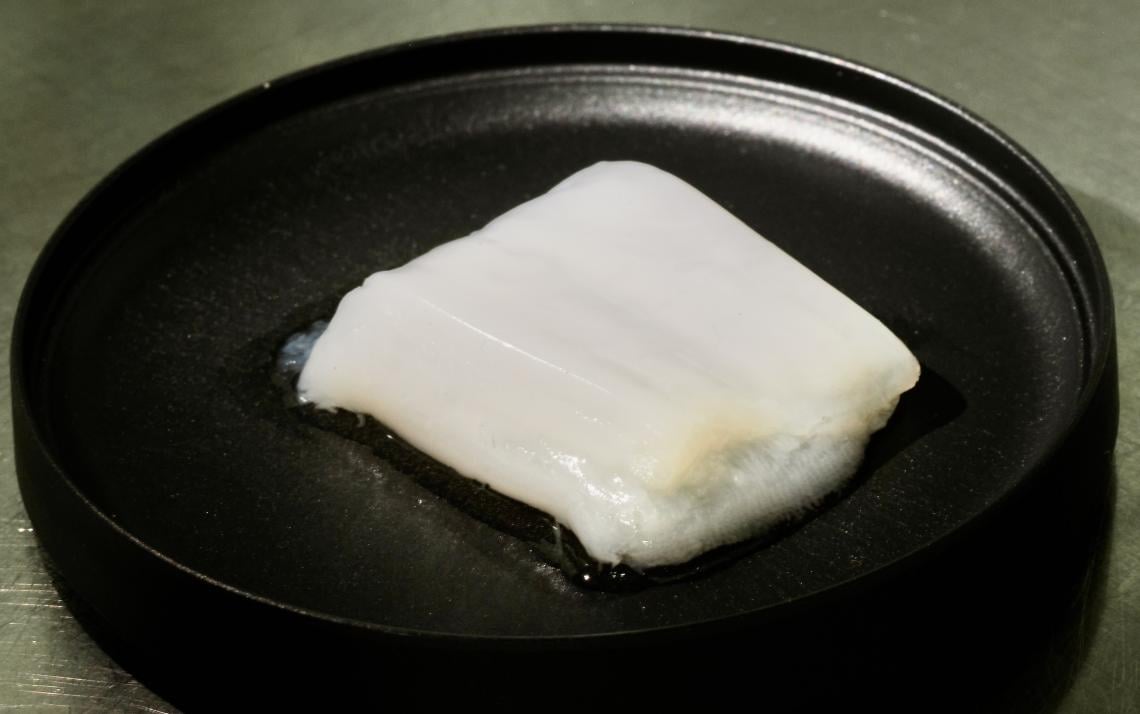
Cultured chicken meat produced from animal cells in a laboratory.
このインタビューを日本語で読む
Could you tell us about the background of research on lab-grown meat?
Professor Takeuchi (hereinafter Takeuchi): The concept of cultured meat has been around for over 10 years. In 2013, Professor Mark Post from the Netherlands announced the first cultured meat hamburger. Since then, over 200 start-up companies around the world have entered this field. It has already been commercialised in Singapore, but what is sold as “cultured meat” is made by mixing a few percentages of animal cells with plant-based materials. The meat made entirely of [animal] cells that ordinary people would imagine is not yet actually realised. There are many approaches to cultured meat. For example, one approach involves collecting small clumps of cells, moulding them into a bigger piece and using them like minced meat. Others include mixing animal cells into soybean paste and processing it into a steak-like product.
What is new about your recent research on lab-grown chicken nuggets?
Takeuchi: In our research, we aim to increase the proportion of animal cells in our products as much as possible, to make them closer to real meat. Meat is made from muscle, which is made up of muscle fibres formed by the fusion of muscle cells. When these muscle fibres are aligned in one direction, a structure similar to real muscle tissue is created. We have been focusing on how to reproduce such a structure in a laboratory.
In our previous results, we succeeded in constructing thick muscle tissue by aligning muscle fibres in one direction. However, the issue was that when the tissue reached a certain thickness, nutrients could not reach the entire tissue, causing cells to die.
In our recent paper published in Trends in Biotechnology1, we used a thin semipermeable tube called a hollow fibre. This tube, which is used for kidney dialysis, is designed so that nutrients can gradually seep to the outside of the tube when water or culture medium flows inside of it. By arranging many of these tubes in parallel and culturing chicken cells around them, we were able to deliver nutrients throughout the cells even to thicker tissue.
While most of our research had previously used cow cells, this time we focused on chicken cells to show that the same method can be applied to different cell types.
How was your research received by the overseas media?
Takeuchi: We don't follow in detail how much coverage we received, but we were featured in Nature2 and other publications so I feel that the response was great. We also received interview requests from several overseas media, and due to the time difference, we mainly responded by email. Previously, we were interviewed by the Associated Press and Reuters about another research project, and we have even had full-scale interviews with cameras. This time, it wasn't like that but I do feel the interest around this research was high.
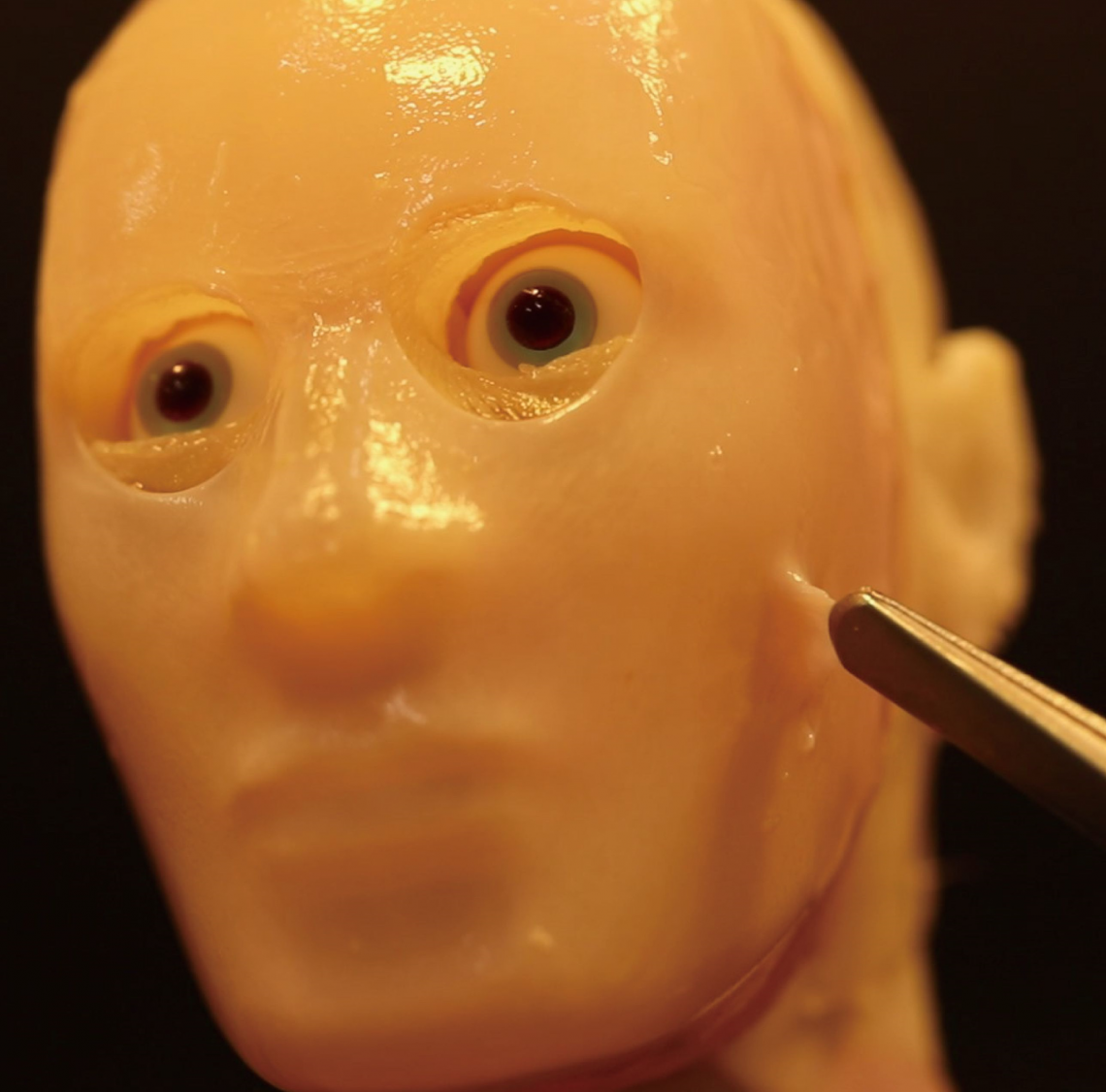
A bio hybrid robot - a robotic face covered with cultured skin gathered much media attention at home and abroad.
Did you feel any difference in how domestic and overseas media picked up your research?
Takeuchi: I have the impression that there is no big difference between domestic and overseas media on cultured meat. However, I feel that the response from overseas media is particularly large in the field of "bio hybrid robots", another project that we are working on. Research on a robot covered with skin is unprecedented, and has attracted a lot of attention.
In Japan, we get a lot of questions about technical challenges and possible applications while with the overseas media, we often get philosophical questions like "Where is the boundary between humans and machines?". I think there is a lot of interest in more fundamental issues, such as how giving robots muscles and skin will affect our outlook on life and society in the future.
What do you think is the significance of being featured in the overseas media?
Takeuchi: I think it is very significant that we can disseminate our research results to the world. One of our missions as researchers is to publish our results through papers and change the world. However, the reality is that papers are technical and difficult for the general public to understand. By conveying our research in an easy-to-understand manner through the media, it can deepen how society understands our research. The feedback we get from the public can sometimes give us new directions for our research.
In addition, especially in the field of engineering, it is important to develop a technology that can benefit society. Unique ideas can create a new value, but it is meaningless if they are not aligned with the values and needs of the society. I think that gaining widespread recognition through the media and receiving feedback is one way to make research more socially meaningful.
Is there any feedback from the society that you can share with us?
Takeuchi: Regarding cultured meat, there is a clear division between favourable opinions such as "I want to try it" and negative opinions such as "I don't want to eat it." In particular, the voices that say "I don't want to eat it" are extremely important in considering the direction of the development of cultured meat.
We regularly conduct surveys both in Japan and overseas, carefully analysing the reasons why people would not want to eat it. Based on the results, we use them to develop products that are more accepted. I think that listening to the voices of society when developing a new technology will ultimately lead to research that takes root in society.
Do you have any advice for researchers who have no experience dealing with international media?
Takeuchi: I would like researchers to actively promote research from Japan to overseas. There is a lot of excellent research in Japan.
If a paper is published in a top journal, it will be recognized among experts. However, it is difficult for it to reach the general public. Therefore, exposure to the overseas media is an effective way to convey innovation from Japan to the world. We believe that in order to raise our profile as an international university, it will become increasingly necessary for us to proactively disseminate information on research abroad.
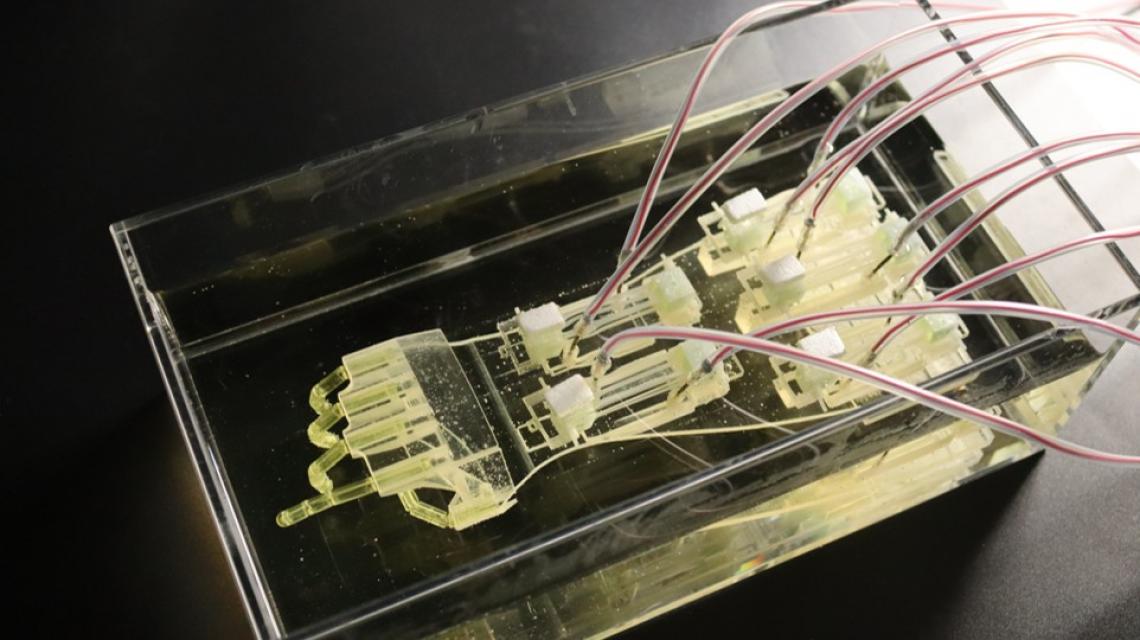
A bio hybrid robotic hand combines a mechanical hand with bundles of cultured muscles to imitate human-like movements,
1 https://www.sciencedirect.com/science/article/pii/S016777992500085X
2 https://www.nature.com/articles/d41586-025-01227-4
Selected media coverage
*From Jan to Aug this year (at the time of publication), Asia Research News noticed approximately 750 news articles mentioning Prof. Takeuchi's research.
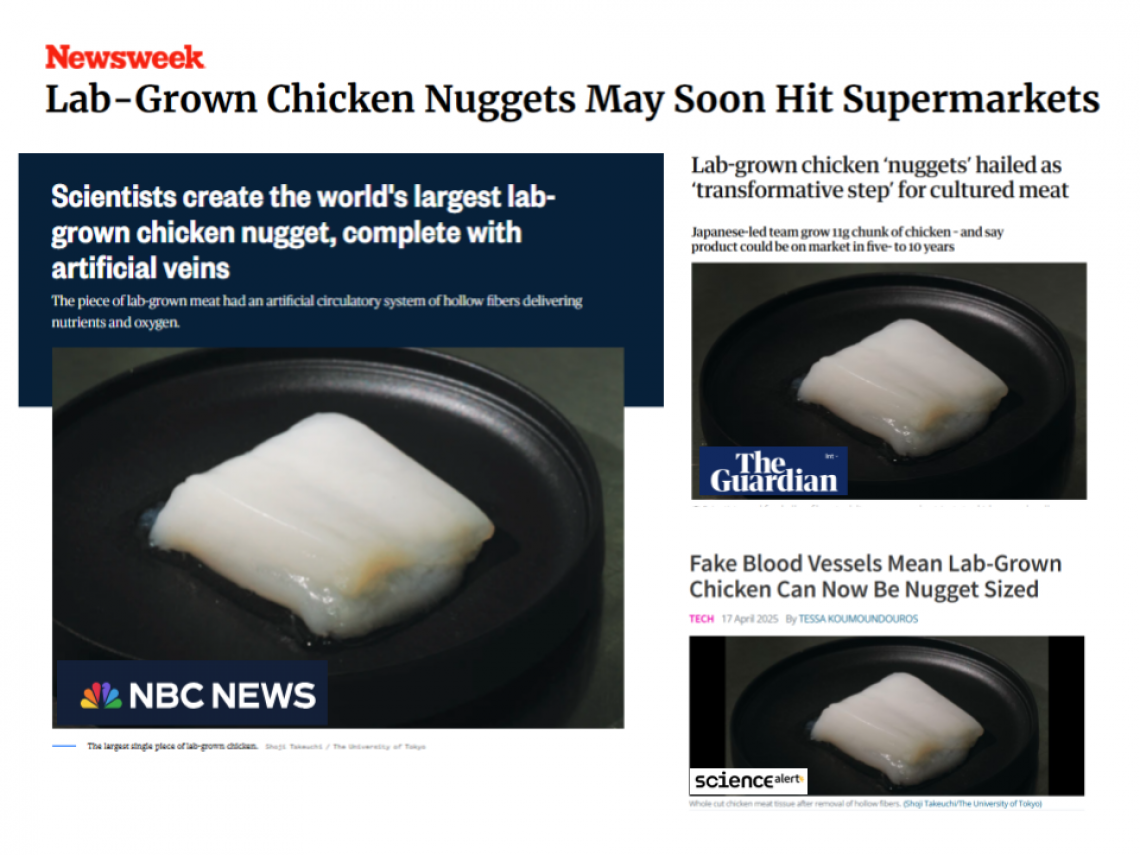
Screenshots of selected media coverage and the outlets on cultured chicken nuggets.
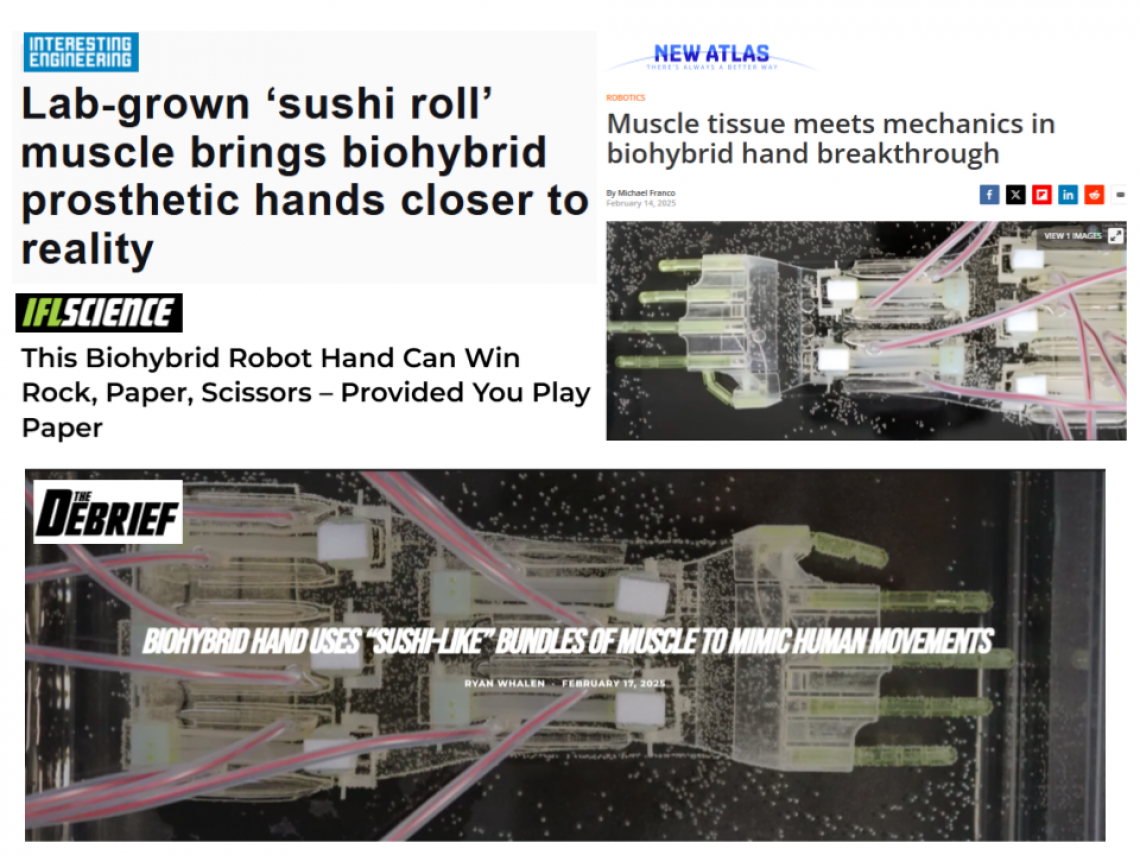
Screenshots of selected media coverage and the outlets on a bio hybrid robot.
Get the news in your inbox