

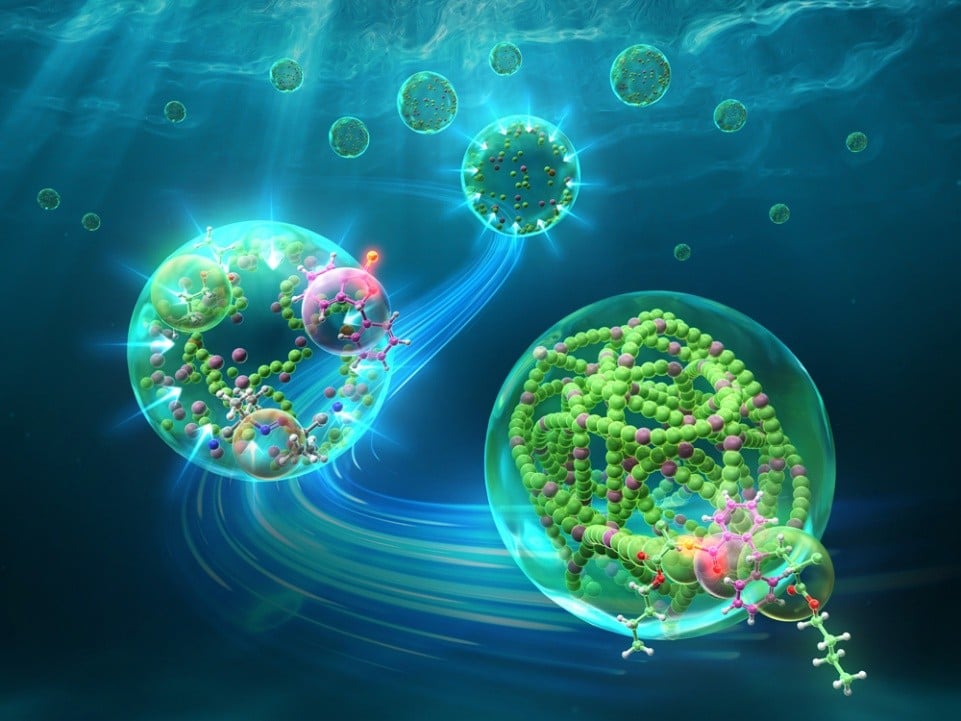

A new polymerization method harnesses Laplace pressure generated within microscopic droplets to synthesize degradable plastics.
Making degradable plastics using Laplace pressure: A reaction using Laplace pressure takes place using the properties of the surrounding nanoscale droplet. The increased pressure inside the droplet unlocked normally inaccessible parts of the monomer’s ring structure, increasing the parts that could be used to make plastics.
Osaka Metropolitan University
Using a new technique, a research group led by Osaka Metropolitan University (OMU) has substantially increased the range of plastics that can be degraded naturally.
“Our findings greatly expand the range of materials available for the production of degradable plastics,” Associate Professor Yukiya Kitayama of the Graduate School of Engineering said.
To make plastics degradable, researchers typically look at their basic building blocks, known as monomers and how chemical bonds bind them together. In the natural environment, many plastics don’t fully degrade because of the bonds, causing them to break down into microplastics, which persist in the environment.
Instead of taking the typical molecular design approach to the problem,the research group looked to changing the physical environment of the chemical reactions using pressure, a seldom used technique.
To maximize pressure, they performed the reactions inside nanoscale droplets. This took advantage of a principle known as Laplace pressure, where the smaller a droplet is, the greater the pressure inside it is due to surface tension. The tiny droplets created such intense pressure, they promoted chemical reactions that would not usually occur.
The researchers were able to unlock normally inaccessible parts of the monomer’s ring structure and use them to create different bonding locations. The enhanced control over the process enabled the creation of plastics with more degradable properties.
As a result,materials that were previously considered unsuitable for polymerization could be polymerized, increasing the range of plastics that could be created without the need for complex structural modifications.
“Our method could be used to develop environmentally friendly plastics that can be reliably degraded after use and will help address the growing problem of plastic waste,”Kitayama said.
“Because the method does not require particularly complex or specialized processes, it can be readily implemented in industrial manufacturing,” he continued.“The concept of using pressure as a tool to drive chemical reactions represents a new approach that could open new possibilities across a broad range of chemical processes.”
The findings were published in Macromolecules.
Financial Interest Statement
The authors declare no competing financial interest.
###
About OMU
Established in Osaka as one of the largest public universities in Japan, Osaka Metropolitan University is committed to shaping the future of society through the “Convergence of Knowledge” and the promotion of world-class research. For more research news, visit https://www.omu.ac.jp/en/ and follow us on social media: X, Instagram, LinkedIn.
Advertisement
Advertisement